

Patent Services
Introduction
Innovent IP provides comprehensive patent services to inventors, startups, MSMEs, universities, research institutions, and businesses seeking to protect and commercialize their innovations. From patentability assessments and patent drafting to filing, prosecution, hearings, and international patent strategies, we support clients throughout the entire patent lifecycle. Our objective is to help innovators secure robust patent protection, safeguard their technological advancements, and maximize the commercial value of their intellectual property in India and international markets. Whether you are filing your first patent application or managing a growing patent portfolio, we offer practical, professional, and client-focused support tailored to your specific requirements.
Patent Drafting and Filing
A well-drafted patent specification forms the foundation of effective patent protection. We assist inventors, startups, researchers, and businesses in preparing comprehensive patent specifications that clearly describe the invention and support strong patent claims. Our services include drafting provisional and complete specifications, filing patent applications before the Indian Patent Office, and guiding applicants through the procedural requirements of the patent registration process.
Patent Prosecution and FER Response
Obtaining a patent often requires addressing objections raised by the Patent Office during examination. We assist clients in preparing responses to First Examination Reports (FERs), addressing technical and legal objections, and presenting persuasive arguments in support of patentability. Our objective is to help applicants navigate the examination process efficiently and maximize the prospects of securing patent protection.
Patent Hearings and Representation
Where required, we represent applicants during hearings before the Patent Office and prepare written submissions to address outstanding objections. We work closely with inventors and applicants to develop strategies that effectively communicate the novelty, inventive step, and industrial applicability of the invention.
Patentability Searches
Before investing time and resources in patent protection, it is often advisable to assess whether an invention is likely to satisfy the patentability requirements. We assist clients with patentability and prior-art searches to identify relevant existing technologies, published patent applications, granted patents, scientific literature, and other publicly available disclosures. These searches help inventors understand the novelty of their inventions, evaluate potential patentability, and make informed decisions regarding filing strategies and further research and development activities.
Patent Oppositions
Patent opposition proceedings provide an opportunity to challenge the grant or proposed grant of a patent under specified circumstances. We assist clients in matters relating to pre-grant and post-grant oppositions, including the preparation of notices, statements, evidence, and legal submissions. Whether seeking to defend a patent application or challenge a competing patent, we help clients navigate opposition proceedings before the Indian Patent Office in a strategic and effective manner.
Patent Services for Foreign Applicants
India represents a significant market for innovation-driven businesses, making patent protection an important consideration for foreign applicants. Innovent IP assists overseas companies, universities, research institutions, startups, and individual inventors with filing and prosecuting patent applications in India. Our services include convention applications, PCT national phase entries, FER responses, hearing representation, and coordination with foreign patent attorneys. We strive to simplify the Indian patent process and provide reliable support for clients seeking protection in one of the world’s largest and fastest-growing economies.
PCT and International Patent Filing
For clients seeking protection beyond India, we provide guidance on international patent strategies, including Patent Cooperation Treaty (PCT) applications and foreign filing procedures. We help applicants evaluate filing options, manage international deadlines, and coordinate with foreign associates to support global patent protection objectives.
Startup & MSME Benefits
The Indian patent system provides several benefits to eligible startups and MSMEs, including reduced official fees and access to expedited examination in qualifying cases. These measures are intended to encourage innovation and facilitate faster commercialization of technology. We assist startups and MSMEs in understanding available benefits, preparing appropriate documentation, and developing patent strategies that align with their business objectives and growth plans.
Industries Served
Innovent IP supports clients across a diverse range of technological and industrial sectors. Our experience includes matters relating to software and information technology, artificial intelligence, electronics and telecommunications, mechanical engineering, medical devices, biotechnology, agricultural technologies, consumer products, manufacturing processes, renewable energy solutions, and emerging technologies. We work closely with innovators to understand the technical and commercial aspects of their inventions and provide intellectual property solutions tailored to their specific industries.
Patent Filing Process
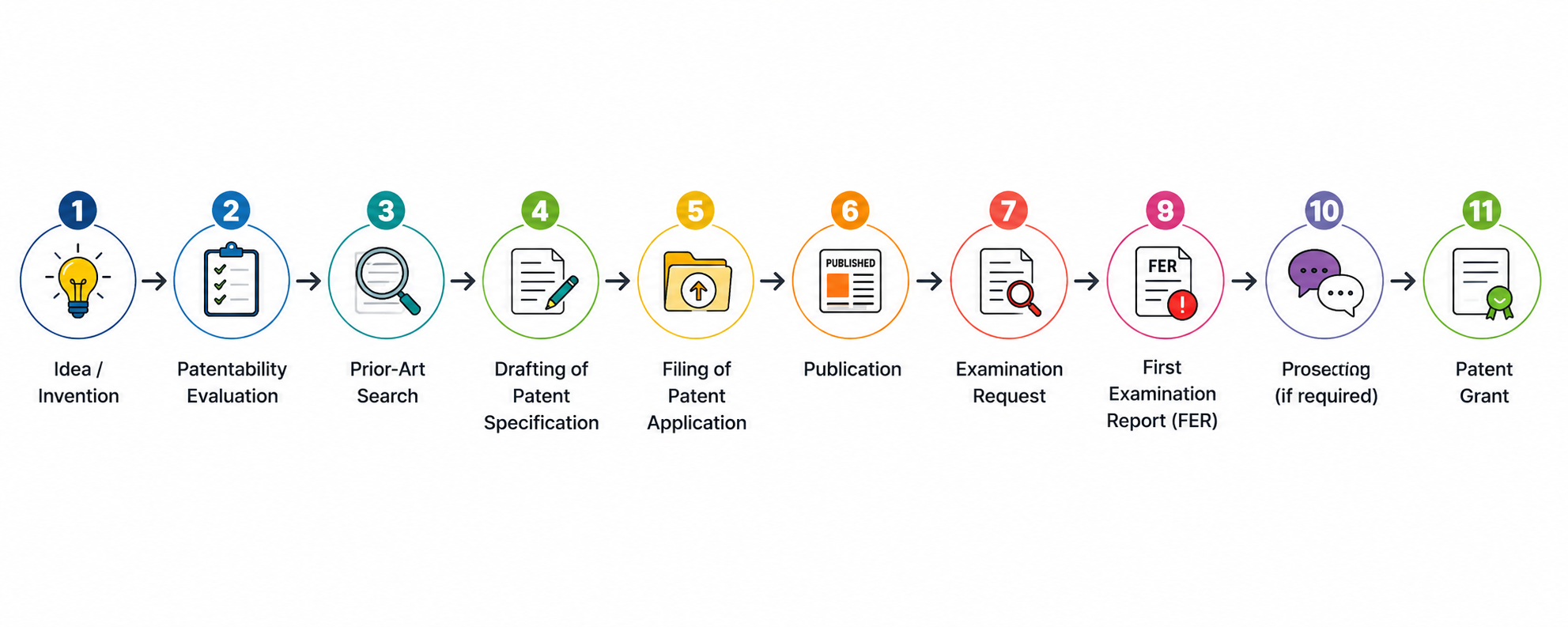
The patent filing process generally involves the following stages, although specific requirements and timelines may vary depending on the nature of the invention and the filing strategy adopted:
Why Choose Innovent IP
At Innovent IP, we combine technical understanding with practical intellectual property expertise to help innovators protect and maximize the value of their creations. Led by a Registered Patent Agent, we provide personalized assistance across patents, trademarks, designs, copyrights, and international IP filings. We work closely with startups, MSMEs, universities, researchers, and businesses to develop effective protection strategies tailored to their specific needs. From the initial assessment of an invention or brand through registration, prosecution, and ongoing portfolio management, our focus remains on delivering clear guidance, responsive service, and high-quality intellectual property solutions that support innovation and business growth.
Frequently asked questions
What is the patent filing process in India?
The patent filing process in India generally involves evaluating the invention, preparing a patent specification, filing the application with the Indian Patent Office, publication of the application, requesting examination, responding to examination reports, and obtaining grant if the invention satisfies the patentability requirements. The exact procedure may vary depending on the nature of the invention and the filing strategy adopted.
How long does it take to obtain a patent in India?
The time required to obtain a patent in India varies depending on factors such as the technology field, examination timelines, and the complexity of objections raised during prosecution. While expedited examination may reduce timelines in eligible cases, the patent grant process generally takes several years from the filing date.
Can foreign applicants file patents in India?
Yes. Foreign individuals, companies, universities, and research institutions may file patent applications in India. Applications may be filed directly before the Indian Patent Office or through international filing mechanisms such as the Patent Cooperation Treaty (PCT). Professional representation can help ensure compliance with Indian patent law and procedural requirements.
What is a PCT application?
A Patent Cooperation Treaty (PCT) application provides a unified procedure for seeking patent protection in multiple countries through a single international filing. While a PCT application does not itself result in an international patent, it allows applicants additional time to evaluate commercial opportunities and pursue patent protection in selected countries.
What is a First Examination Report (FER)?
A First Examination Report (FER) is an official communication issued by the Patent Office after examination of a patent application. The report may contain objections relating to novelty, inventive step, clarity, patentable subject matter, or procedural requirements. Applicants are generally required to respond to these objections within the prescribed period to advance the application toward grant.
Do I need a patent search before filing?
Although a patent search is not mandatory, it is often highly beneficial. A prior-art search can help identify existing technologies, assess the likelihood of obtaining patent protection, refine the invention, and support informed filing decisions. Conducting a search before filing may reduce uncertainty and improve the overall patent strategy.
Can software be patented in India?
Software-related inventions may be patentable in India when they demonstrate a technical effect or technical contribution and satisfy the statutory patentability requirements. Patentability depends on the specific features of the invention and the manner in which it is claimed.
What is the difference between a provisional and complete specification?
A provisional specification allows an applicant to secure an early filing date while providing additional time to further develop the invention before filing a complete specification. A complete specification must fully describe the invention and define the scope of protection sought through patent claims.
Can startups obtain reduced patent filing fees?
Yes. Eligible startups and MSMEs may benefit from reduced official fees under the Indian patent system. Additional incentives and expedited examination options may also be available subject to the applicable legal requirements.
What rights does a patent provide?
A granted patent generally provides the patent owner with the exclusive right to prevent others from making, using, selling, offering for sale, or importing the patented invention without authorization within the jurisdiction where the patent is in force.
How long does patent protection last?
In India, the term of a patent is generally twenty years from the filing date of the application, subject to the payment of prescribed renewal fees and compliance with applicable legal requirements.
What happens after a patent is granted?
Following grant, the patent proprietor acquires enforceable rights in relation to the patented invention. Patent owners should maintain the patent through payment of renewal fees and may choose to commercialize the invention through manufacturing, licensing, technology transfer, collaboration, or other business arrangements.
Can I file a PCT application based on my Indian patent application?
Yes. In many cases, an Indian patent application may serve as the priority application for a subsequent PCT filing, provided the relevant deadlines are observed. This approach enables applicants to preserve priority rights while considering patent protection in multiple jurisdictions.